AI-Enabled Infrastructure for the Industrial & Hazardous Waste Industry
Simple. Connected. Transparent. The operating system that powers $950M in annual industry transactions.
An analog industry running on paper and PDFs.
Industrial and hazardous waste is one of the most regulated, document-heavy, and operationally complex industries in the U.S., and most of it still runs on emails, phone calls, and disconnected legacy tools.
Waste Profiles
Hundreds of fields, endless review cycles, and delayed approvals trapped in disconnected PDFs.
Manifests & Shipments
Paper-compliant EPA documentation that is easily lost, hard to track, and difficult to reconcile.
Receiving & Invoicing
High-volume reconciliation processes that require manual data entry across multiple legacy systems.
Regulatory Reporting
Complex state, federal, and local compliance requirements managed in fragmented spreadsheets.
One platform for every waste transaction.
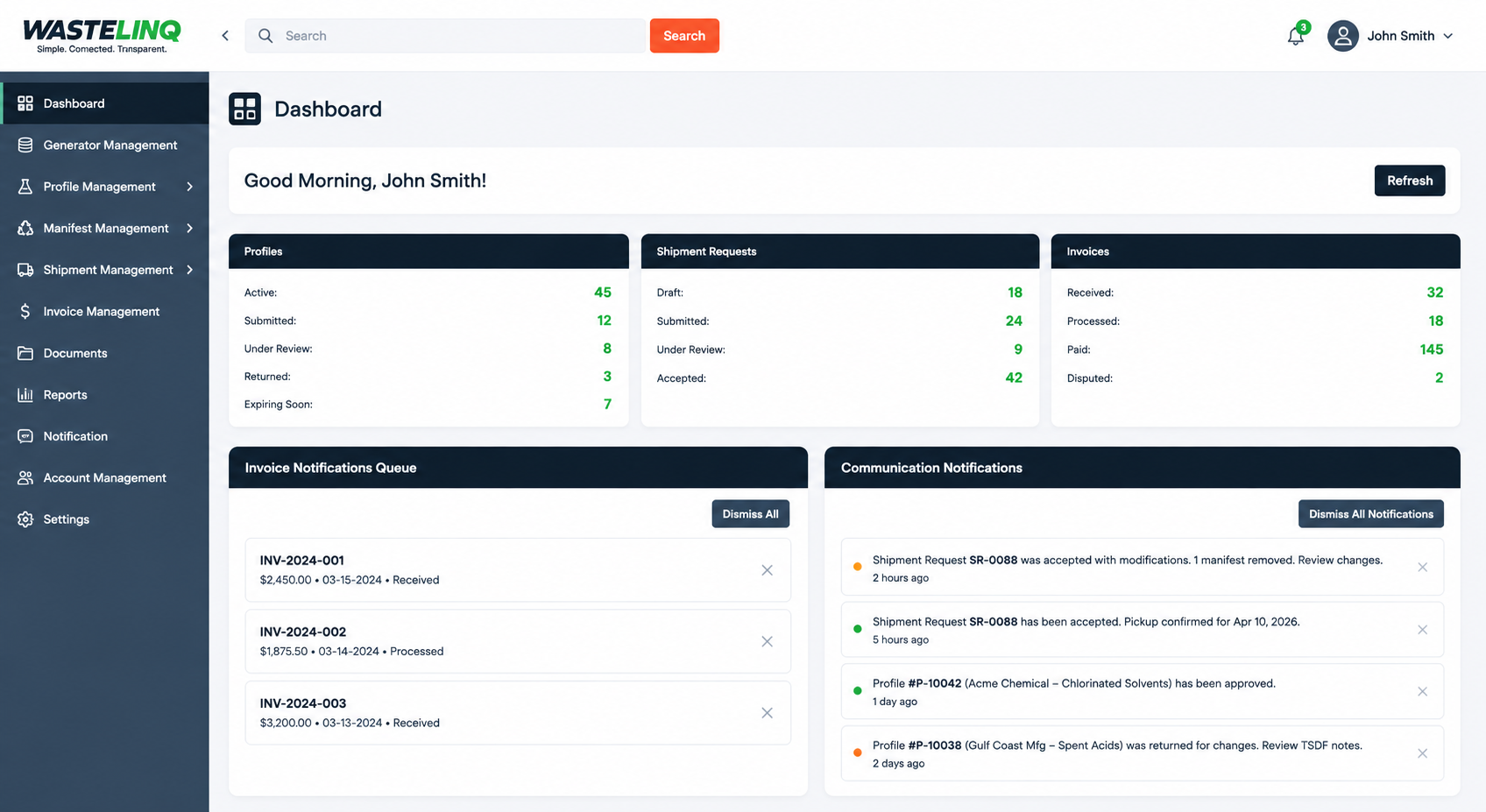
A single AI-enabled system of record connecting your entire operational workflow. Move beyond fragmented data and build a scalable foundation.
Waste Profiles
Create, review, approve, and version
Shipments & Orders
Scheduling, routing, and pricing
Receiving & Processing
Scan, weigh, consolidate, and treat
Invoicing
Line-item billing and Accounts Receivable
Regulatory Reporting
EPA, state, and local compliance
Document Management
Profiles, manifests, SDSs, and LDRs
Customer Portal
Self-serve access for generators
One platform. Every transaction.
Integrated with your accounting system of record.
Proven at Scale
The operating system of industrial & hazardous waste.
AI-native agents for hazardous waste transactions.
Our ASSIST suite automates the high-volume, error-prone work that every company in this industry still does by hand.
Profile ASSIST
Scrape SDSs & paper profiles, predict approvals, and submit via customer portals automatically.
Manifest ASSIST
Scrape, validate, and e-file manifests with EPA. Finals retrieved automatically with zero manual filing.
RRC Waste Automation
Texas Railroad Commission waste reporting — the first automated solution of its kind in the industry.
Procurement ASSIST
Invoice review, discrepancy detection, and cost allocation to routes and profiles.
Approval ASSIST
Intelligent approvals across generators, service providers, and TSDFs without the back-and-forth.
Reporting ASSIST
Automated federal, state, and local compliance reporting: delivered, not assembled.
Point solution or full operational ERP.
WasteLinq is modular by design. Start where the pain is and scale to the whole back office when you're ready.
Targeted Point Solution
Drop into your existing workflows. Run alongside your current tools and start solving a specific problem fast.
- Drop into existing workflows alongside your current ERP
- Solve one problem exceptionally well: Profile ASSIST, Manifest ASSIST, customer portal
- Quick to deploy with measurable ROI in weeks, not quarters
- Upgrade path as needs grow, no re-platforming required
Comprehensive Operational ERP
Run the entire back office from one system. Full visibility across every generator, service, and disposal transaction.
- Profiles, orders, receiving, invoicing, and reporting in one system
- Pre-built integrations with QuickBooks, NetSuite, Acumatica and SAP
- One source of truth across generators, service, and disposal
- EPA, state, and local compliance built into every workflow
Built for every link in the industrial waste value chain.
300+ companies run on WasteLinq today — including many of the major U.S. Treatment, Storage, and Disposal Facilities.
TSDFs
Treatment, Storage & Disposal Facilities
- Inbound processing and profile review
- Manifest and e-manifest workflows
- Receiving and consolidation
- Invoicing and billing
- Compliance reporting
- Customer Portal
Service Providers
Environmental Service Companies
- Quote-to-cash workflow management
- Dispatch and Scheduling Optimization
- Profile management at scale
- Subcontractor oversight
- Customer portals and disposal integrations
Transporters
Hazardous Waste Carriers & Logistics
- Manifest creation and management
- DOT compliance and hazmat documentation
- Real-time reporting and operational visibility
- Shipment Tracking
- Bill of lading and shipping paper management
Generators
Industrial & Commercial Waste Generators
- Self-serve profile submission
- Shipment tracking and visibility
- Document archive management
- Compliance visibility across sites
- Multi-vendor management
WasteLinq's suite of products includes Terralink, Enviroware, and WasteLinq Enterprise.
Purpose-built for this industry. Proven. AI-native.
Generic ERPs and workflow tools don't understand waste. We do — and we've been building for it for nearly 25 years.
Purpose-Built for IHW
Not a generic ERP bent into shape. Every workflow from profile to invoice is designed around how hazardous and industrial waste actually moves.
AI-Native ASSIST Suite
Modern agentic automation for the transactions that still run on paper: profiles, manifests, invoices, and regulatory reports.
25 Years of Domain Expertise
Deep, battle-tested understanding of TSDF, service provider, and generator operations and the regulatory fabric that binds them.
Scales With You
Start with one module. Grow into a full operational ERP. No re-platforming, no vendor swap, no disruption to what already works.
Accounting-System Ready
Pre-built integrations with QuickBooks, NetSuite, Acumatica and SAP. One source of truth across your operations and books.
Proven at Scale
$950M in 2025 industry transactions. $1.2B forecast for 2026. Most major U.S. TSDFs already running on the platform.
Common questions about WasteLinq.
What WasteLinq does, who it serves, and how it fits hazardous and regulated waste operations.
Nearly 25 years of building for this industry.
WasteLinq was built by people who have worked in industrial and hazardous waste — not generalist software engineers retrofitting a CRM. Every feature reflects decades of lived operational experience.



Chief Technology Officer
Technology executive and product leader with 20+ years of experience spanning SaaS, ERP, workflow automation, and industrial technology platforms. An active voice in the technology community, focused on digital transformation, AI, product strategy, and operational innovation.


Recognition & Certifications

Top Hazardous Waste Management Solution
Environmental Business Review · 2025

Top Waste Management Solutions Provider
Environmental Business Review · 2023

SOC 2 Type II Certified
AICPA · Thoropass · 2025

Best Place for Working Parents
2024

Greater Tomball Area Chamber of Commerce
Member

Enfinite
Technology Partner
What challenges are you hoping to solve?
Our customers use WasteLinq Enterprise as targeted point solutions to resolve specific challenges, or as a comprehensive operational ERP integrated with their accounting systems. We'd love to learn more about your current needs.
Request a Demo
Tell us a bit about your operation and we'll show you exactly how WasteLinq fits, whether you're looking to solve one specific challenge or run your entire back office on one platform.